

Procurement Is No Longer a Cost Function. It Is a Growth Engine.
For some equipment manufacturers, procurement still lives in a very small box.
That box is labelled "savings". Cost reduction. Price negotiation. Annual targets. Supplier consolidation. And while cost absolutely matters, something far more powerful is being missed.
In 2026, procurement is not just a control function. It is a growth engine! We said it !
The truth is this. In many businesses, supply chain decisions made quietly in conference & technical / engineering rooms have a greater impact on revenue growth than marketing campaigns ever will.
Think about your last product launch.
When did procurement become involved
After drawings were frozen
After tooling was committed
After cost targets were already assumed
By that stage, most of the commercial outcome was already locked in. In manufacturing, design decisions made early determine the majority of lifecycle cost, service performance, and even future sourcing flexibility. Yet supplier expertise is often invited too late.
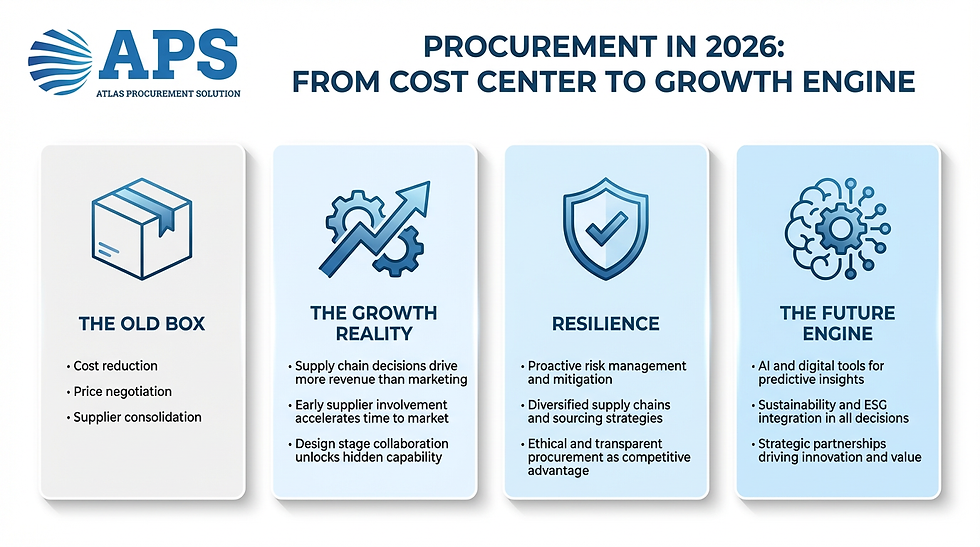
The most progressive manufacturers I work with do something different. They bring strategic suppliers into early design conversations. Not to give control away. But to unlock capability.
Cable assembly partners advising on routing & OEM simplification.
PCBA suppliers identifying component rationalisation opportunities.
Power electronics partners suggesting alternative architectures that reduce heat risk and warranty exposure.
Housing vendors that advise against specific materials for processing quality & output!
That early collaboration does more than reduce cost. It reduces friction. It reduces redesign. It reduces time to revenue!
Speed to market in manufacturing is margin!
Then there is resilience.
Many leadership teams believe they are diversified because they have more than one supplier, although I've worked with people that are singled sourced and not because the market dictates it. But when we map revenue exposure rather than spend exposure, a different picture emerges.
It is common to discover that a single geography quietly underpins a significant portion of total company revenue. Not spend. Revenue. If a disruption occurred tomorrow, how much turnover would pause? That question shifts procurement input from operational to strategic very quickly.
Growth focused procurement teams ask different questions.
Where are we technically locked in?
Which components would take months to requalify?
Where is our margin dependent on one factory?
Which suppliers influence customer perception of quality?
This is not defensive thinking. It is competitive thinking!
Because the manufacturers who recover fastest when disruption hits are the ones who capture market share & really importantly keep things simple in the supply chain, while others stabilise.
There is also a more subtle growth lever that rarely gets attention.
Structural efficiency. In manufacturing I regularly see hidden margin erosion sitting in plain sight.
Excess part proliferation.
Multiple suppliers providing near identical components.
Minimum order quantities that inflate working capital & piece part price
Forecast volatility that creates unnecessary & needless buffer stock.
Regional fragmentation that adds logistics complexity & Co2.
Individually these issues feel small. Collectively they compound over & over! 3% here, 2% there. A little more inventory than necessary. Slightly longer lead times than optimal. Over time, this becomes structural drag. When procurement steps into the role of architect rather than negotiator, things shifts.
The conversation becomes about system design rather than price pressure.
Supplier footprints are rationalised.
Complexity is reduced.
Forecast alignment improves.
Working capital frees up.
Engineering and procurement operate as one team rather than two silos. (SO SO IMPORTANT!
That is not just cost improvement. That is margin engineering!
The companies that recognise this shift are not louder about it. They are simply more intentional.
They treat procurement capability as a competitive asset.
If you are leading an equipment manufacturing business today, it may be worth asking a simple question.
"Is your procurement function structured to protect margin"? Or.... "structured to create advantage"?
The difference is significant. And in my experience, unlocking that difference often begins with an outside perspective and a willingness to challenge long standing assumptions.
How Atlas Procurement Solution Can Help
At Atlas Procurement Solution, we work with UK businesses to protect margins through practical procurement support, not theory and not generic frameworks.
That means driving supplier improvements
Reducing avoidable cost
Building resilience into the supply base
Making sure procurement is actively supporting growth, not holding it back
If you are dealing with rising costs, supply chain instability, or you simply want a fresh set of eyes on your procurement strategy, we are here to help.
Want to take control of costs in 2026. Message me directly, or visit www.atlasprocurementsolution.com and drop us a message to arrange a discovery call.


Comments